







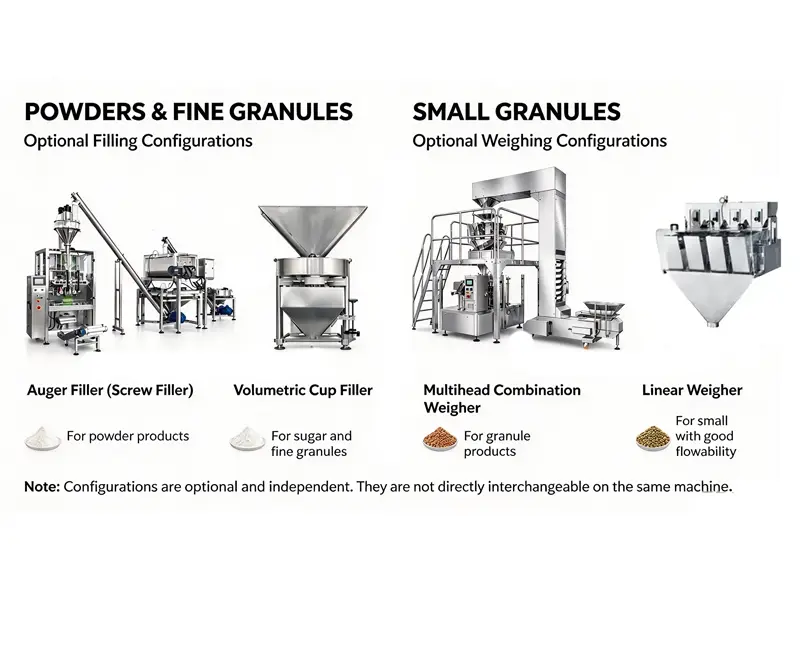
Choosing a packaging machine is not only about selecting a machine that can make bags and fill products. The filling system, target package weight, product characteristics, bag style, and production speed all affect the final configuration.
For example, two products may both be granules, but one may be better suited to a linear weigher while the other may benefit from a multihead combination weigher. Similarly, some powders can be packed using an auger filler, while others may be suitable for volumetric dosing, depending on their properties and the required filling performance.
There is also another important consideration: one packaging machine may not be suitable for every product or every bag type. A machine designed for one application may need additional equipment, change parts, or a different configuration to handle another.
This guide explains the main factors buyers should consider before choosing a packaging machine.
1. Start with the Product: What Are You Packaging?
Before comparing machine models, identify the characteristics of your product.
Granules, powders, liquids, and pastes behave differently during feeding and filling. Even products within the same category can have different flow properties, bulk densities, particle sizes, and sensitivities to handling.
Por exemplo:
- Potato chips are fragile and can break during feeding.
- Rice and millet are free-flowing granules, but their required filling weights and production speeds may differ.
- Milk powder and coffee powder may require different feeding and dosing adjustments.
- Sticky powders may need special attention to prevent buildup or inconsistent feeding.
These differences affect the feeding structure, measuring device, hopper design, and other machine components.
Dica prática: When requesting a quotation, provide the product name, a sample or clear product photos, the target weight per bag, the desired production speed, and the intended bag style. These details help a supplier evaluate the application more accurately.
2. Granules: Linear Weigher or Multihead Combination Weigher?
Both linear weighers and multihead combination weighers can be used for granular products. However, they work differently and are not interchangeable in every application.
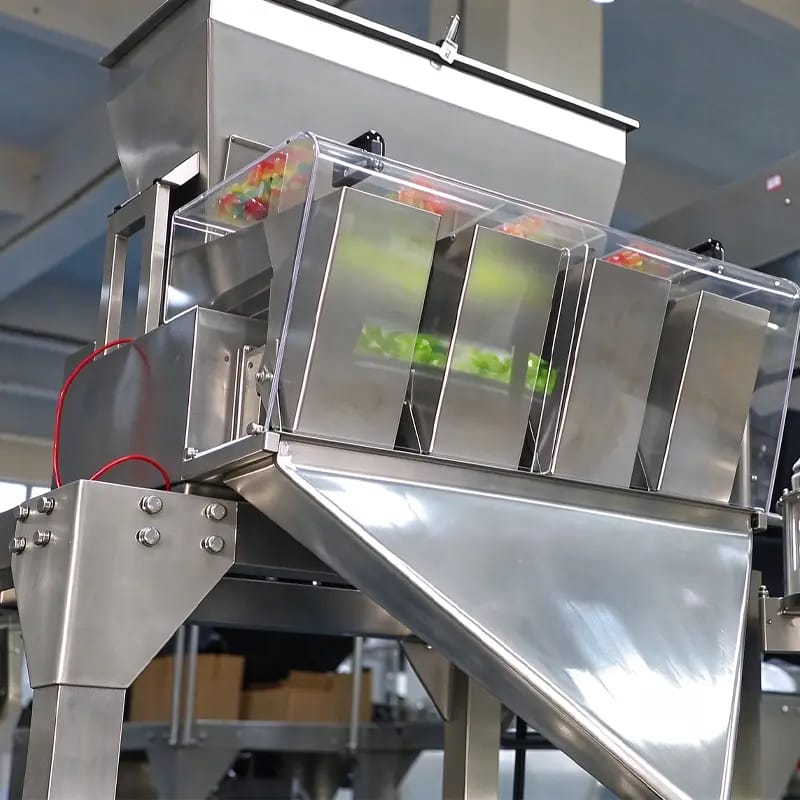
Balança linear
A linear weigher feeds product into a weighing hopper until the target weight is reached. Depending on the design, it may use one or more feeding channels and weighing units.
It can be a practical option for many granular products when the required output, weighing range, and accuracy can be achieved with the selected configuration.
Potential applications include rice, seeds, beans, and other free-flowing granules. Suitability depends on the actual product and machine design.
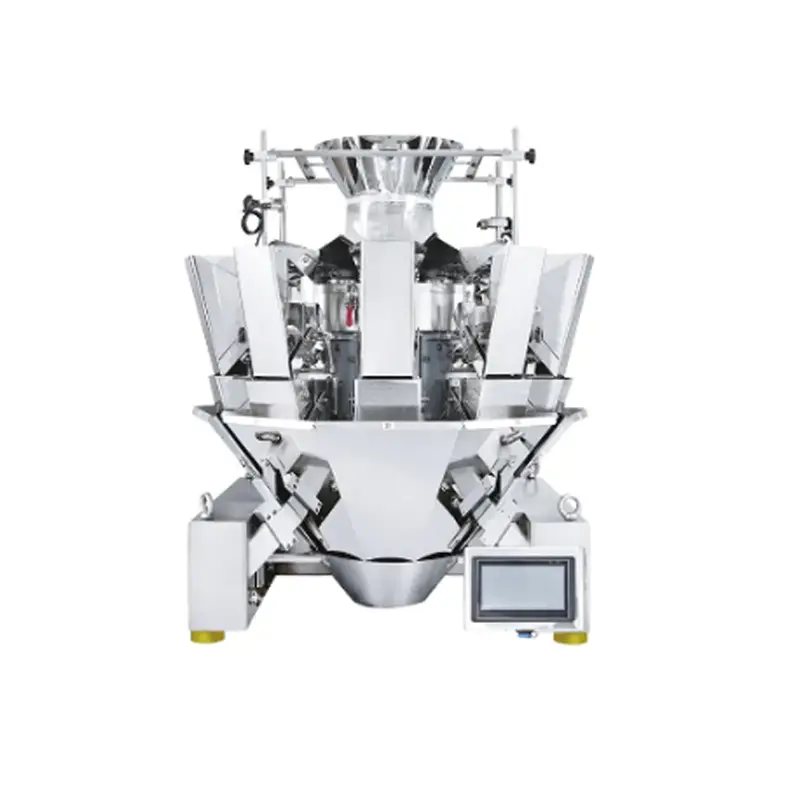
Multihead Combination Weigher
A multihead weigher distributes product into multiple weighing hoppers. A computer then calculates combinations of the available hopper weights and selects a combination close to the target weight, according to the machine's programmed weighing logic.
This approach is commonly used for products such as nuts, snacks, candies, and other discrete food items where fast, controlled weighing is important.
The advantages depend on the product, number of weighing heads, machine design, and operating conditions. A multihead weigher is not automatically the best choice for every granular product.
| Factor | Balança linear | Multihead Combination Weigher |
|---|---|---|
| Measuring principle | Product is weighed in a weighing unit or channel | Multiple hopper weights are combined computationally |
| Common applications | Many granules and relatively straightforward weighing tasks | Snacks, nuts, candies, and other suitable discrete products |
| Main selection factors | Target weight, accuracy, flow characteristics, and required output | Target weight, product handling, weighing performance, and required output |
| Cost considerations | Depends on the number of channels and overall configuration | Depends on head count, design, controls, and integration |
| Is it always the better option? | No; suitability depends on the application | No; suitability depends on the application |
The right choice should be based on the required filling performance, not simply on whether the product is a granule.
For a closer look at how combination weighing works, see Ishida’s guide to multihead weighers, which introduces multihead weighing equipment and its applications.
3. Powders: Auger Filler or Volumetric Cup Filler?
Powder packaging requires special attention because different powders can behave very differently during feeding and filling.
Enchedor de rosca sem-fim
An auger filler uses a rotating screw to move and dispense powder. The screw design, rotation, filling program, and product characteristics affect the amount dispensed.
It is commonly considered for products such as milk powder, coffee powder, flour, and seasoning powders.
However, powder flowability, bulk density, dust generation, and the required dose all affect performance. Some applications may also require agitation or a specially designed feeding hopper.
Volumetric Cup Filler
A volumetric cup filler measures product using a defined volume. It can be suitable for products that fill the measuring cup consistently and have sufficiently stable bulk density for the required package weight.
Because the machine measures volume rather than directly measuring the final product weight, changes in bulk density can affect the actual weight in each package.
| Factor | Enchedor de rosca sem-fim | Volumetric Cup Filler |
|---|---|---|
| Basic principle | A rotating screw dispenses product | A measured volume of product is dispensed |
| Common applications | Many powder products | Suitable free-flowing products with consistent filling behavior |
| Important considerations | Powder flow, dust, density, screw design, and dose | Bulk density, cup volume, product flow, and dose |
| Adjustment | Screw speed, rotation, filling program, and other design-specific settings | Cup volume and other design-specific settings |
| Main limitation | Some powders need special feeding or screw designs | A consistent volume does not guarantee an identical weight if density changes |
For example, two powders may both be sold in 100 g bags, but one may be easy to feed while the other is dusty or prone to bridging. The same filling principle may not perform equally well for both products.
The correct configuration should be confirmed through product evaluation and, where necessary, filling tests.
For additional background on filling equipment and powder-filling considerations, see All-Fill’s FAQs. Use this as supplementary information; the suitable dosing method still needs to be confirmed for the actual product and required dose.

4. Why Does the Target Filling Weight Matter?
The target weight is another important factor when selecting a filling system.
Consider the same product packed in 10 g sachets and 500 g bags. The machine may need different measuring ranges, hopper capacities, feeding arrangements, and operating settings to meet the requirements of each package.
A small sachet may require a dosing device suited to a small filling quantity. A larger bag may require a different weighing range or hopper arrangement. The actual choice depends on the product, required accuracy, and target output.
There is no universal rule that a particular weight always requires a particular filling device.
When evaluating a machine, buyers should confirm:
- Minimum and maximum filling weights.
- Required weighing accuracy or filling tolerance.
- Target packages per minute.
- Whether the same machine must handle several filling weights.
- Whether changing between weights requires new parts or only parameter adjustments.
Important: Ask the supplier to confirm the achievable performance at your actual target weight, rather than relying only on the machine's maximum advertised speed.
5. One Machine May Not Handle Every Product or Bag Type
A common purchasing mistake is assuming that one machine can package all products and bag styles simply because they belong to the same general category.
In practice, compatibility depends on the machine's structure, installed filling system, forming components, sealing method, and available adjustments.
Different Products May Need Different Filling Equipment
A machine configured with a multihead weigher for snacks may not be ready to fill fine powder. Switching from granules to powder could require a different dosing unit, feeding structure, dust-control measures, and cleaning arrangements.
Some machines can be designed for product changeovers, but this capability must be confirmed for the specific model and configuration.
Different Bag Styles May Need Different Machine Structures
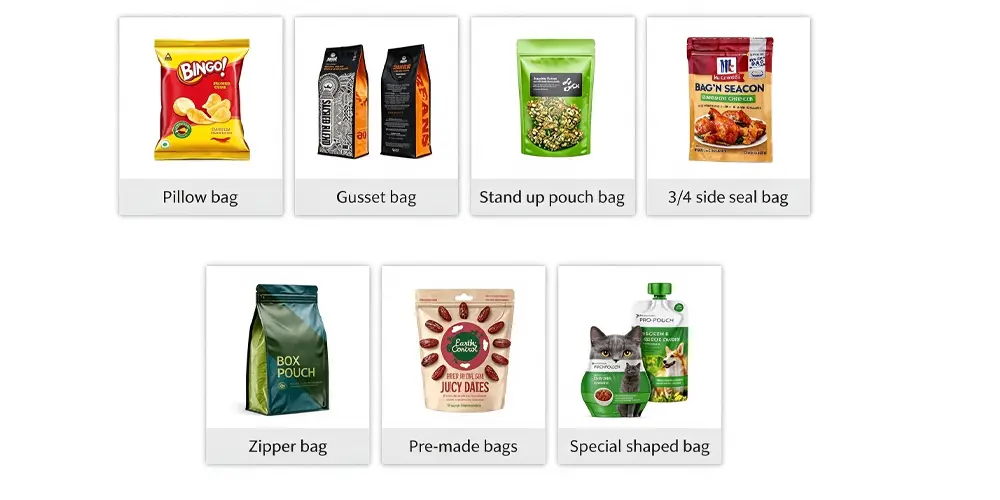
Pillow bags, gusseted bags, stand-up pouches, and zipper pouches are not all produced in the same way.
A vertical form-fill-seal (VFFS) machine forms bags from a roll of packaging film. Depending on its design and options, it may support pillow bags, gusseted bags, or other specified styles.
A premade pouch machine, by contrast, handles bags that have already been manufactured. Stand-up and zipper pouches often require specific pouch-handling and opening functions.
| Customer requirement | What should be checked? |
|---|---|
| One product, one bag size | Filling range, bag dimensions, and required output |
| One product, several bag sizes | Supported size range and whether change parts are needed |
| Several products, same bag style | Filling-system compatibility, cleaning, and changeover procedure |
| Granules and powders | Whether different feeding and dosing systems are required |
| Pillow bags and gusseted bags | Whether the VFFS model supports both and what additional parts are needed |
| Roll film and premade pouches | Whether one machine can support the required packaging process or separate machines are needed |
For examples of different bag formats, see Triangle Package Machinery’s package styles guide. For an overview of vertical form-fill-seal equipment, see Triangle’s VFFS baggers. These resources illustrate available formats and equipment types; compatibility must still be checked against the specific machine model and options.
Before ordering, ask the supplier to list which products and bag styles the quoted configuration can actually handle, which adjustments are included, and which additional components would cost extra.
6. Other Factors That Affect the Final Configuration
The filling device is only one part of the complete packaging machine. The following factors can also affect machine selection.
Manuseio do produto: Fragile products may need gentler feeding and discharge arrangements. Dusty products may need dust-control measures, while sticky products may require special attention to product buildup.
Packaging film: Film material, thickness, width, sealing properties, and printed registration requirements can affect the film-feeding and sealing configuration.
Bag dimensions and style: Bag width, length, gussets, and other features must fall within the machine's supported range.
Production speed: The required output should be evaluated together with filling weight, dosing performance, bag dimensions, and sealing time. Maximum mechanical speed does not necessarily equal achievable production output for every product.
Cleaning and changeover: If several products will run on the same machine, consider how easily product-contact parts can be cleaned, how long changeovers take, and whether cross-contamination is a concern.
Future requirements: If you expect to add products or bag sizes later, tell the supplier before ordering. A suitable configuration may be designed with certain change parts or options, but future compatibility should never be assumed. Some VFFS designs offer features intended to make format changes easier; for one example, see Triangle’s rotatable-jaw VFFS bagger. The available bag styles and changeover requirements vary by model.
7. A Practical Checklist Before Requesting a Quotation
Prepare the following information before contacting a packaging machinery supplier.
| Information to prepare | Por que isso é importante |
|---|---|
| Product name and photos or sample | Helps assess product characteristics and feeding behavior |
| Target filling weight and any other required weights | Helps determine the appropriate measuring range |
| Desired packages per minute | Helps evaluate filling and sealing performance |
| Modelo e dimensões da bolsa | Determines the forming or pouch-handling requirements |
| Packaging film details, if available | Helps evaluate film feeding and sealing compatibility |
| Required weighing accuracy or filling tolerance | Helps establish realistic performance targets |
| Number of products and bag styles | Helps determine changeover and compatibility requirements |
| Cleaning or hygiene requirements | Affects product-contact design and maintenance arrangements |
If possible, provide actual product samples and bag samples. Photos are useful for an initial assessment, but they cannot always reveal how a product flows, settles, breaks, or behaves during filling.
Conclusion: Choose the Configuration, Not Just the Machine Model
The right packaging machine is not necessarily the one that claims to handle the greatest number of products. It is the one whose filling system, bag-forming structure, operating range, and performance match your actual requirements.
Linear weighers, multihead combination weighers, auger fillers, and volumetric cup fillers each have suitable applications. The best choice depends on the product, target filling weight, required speed, accuracy, and budget.
If you need to package several products or bag styles, confirm compatibility before purchasing. Some changes may require only parameter adjustments, while others may need additional components or a different machine configuration.
At FRONTECH, we recommend evaluating the complete application before selecting the equipment. Share your product details, target weight, bag dimensions, desired output, and any future changeover requirements so the appropriate configuration can be assessed for your project.
Frequently Asked Questions (FAQs)
1. How do I choose the right packaging machine for my product?
The right machine depends on your product characteristics, target filling weight, required production speed, bag style, and filling accuracy. Providing product samples or clear photos helps the supplier recommend a suitable configuration.
2. What is the difference between a linear weigher and a multihead combination weigher?
A linear weigher measures product through one or more weighing units, while a multihead combination weigher calculates combinations of weights from multiple hoppers to reach the target weight. The best option depends on the product and required production performance.
3. Should I choose an auger filler or a volumetric cup filler for powder packaging?
An auger filler uses a rotating screw to dispense powder, while a volumetric cup filler measures a set volume. The choice depends on the powder's flowability, bulk density, target filling weight, and required consistency.
4. Can one packaging machine handle different products and bag types?
Not always. Different products may require different filling systems, while different bag styles may require specific machine structures or additional components. Confirm compatibility with the supplier before purchasing.
5. What information should I provide when requesting a packaging machine quotation?
Prepare the product name and photos or samples, target filling weight, desired production speed, bag style and dimensions, packaging film details, and any requirements for handling multiple products or bag sizes. This information helps the supplier assess the appropriate machine configuration.
Referências
1. Ishida. Multihead Weighers. Explains the working principles of multihead combination weighing and how multiple weighing hoppers are combined to achieve the target weight.
https://www.ishida.com/ww/en/products/weighing/ccw/
2. All-Fill. Powder Filling Technology and FAQs. Provides further information on auger filling, powder characteristics, and different powder filling technologies.
https://allfill.co.uk/faqs/
3. Packaging News. Why Many Heads Are Better Than One: Buyers’ Guide to Weighing and Filling. Compares the basic working principles of linear weighing and multihead combination weighing, along with key equipment selection considerations.
https://www.packagingnews.co.uk/equipment/why-many-heads-are-better-than-one-buyers-guide-weighing-and-filling-06-02-2013
4. Tokyo Automatic Machinery Works (TAM). Vertical Form Fill Seal Machines. Introduces VFFS packaging equipment, available configurations, and different packaging formats.
https://www.tam-tokyo.co.jp/english/products/pillow_twjc.html
5. ROVEMA. BVC 260 Form Fill and Seal Machine Operator Manual. Provides technical information about VFFS machine operation and the forming components associated with different bag styles.
https://www.rovema-na.com/hubfs/BVC-260%20Operator%20Manual.pdf
6. PMMI — The Association for Packaging and Processing Technologies. Packaging and Processing Industry Resources. Provides additional resources related to packaging machinery and processing technologies.
https://www.pmmi.org/