







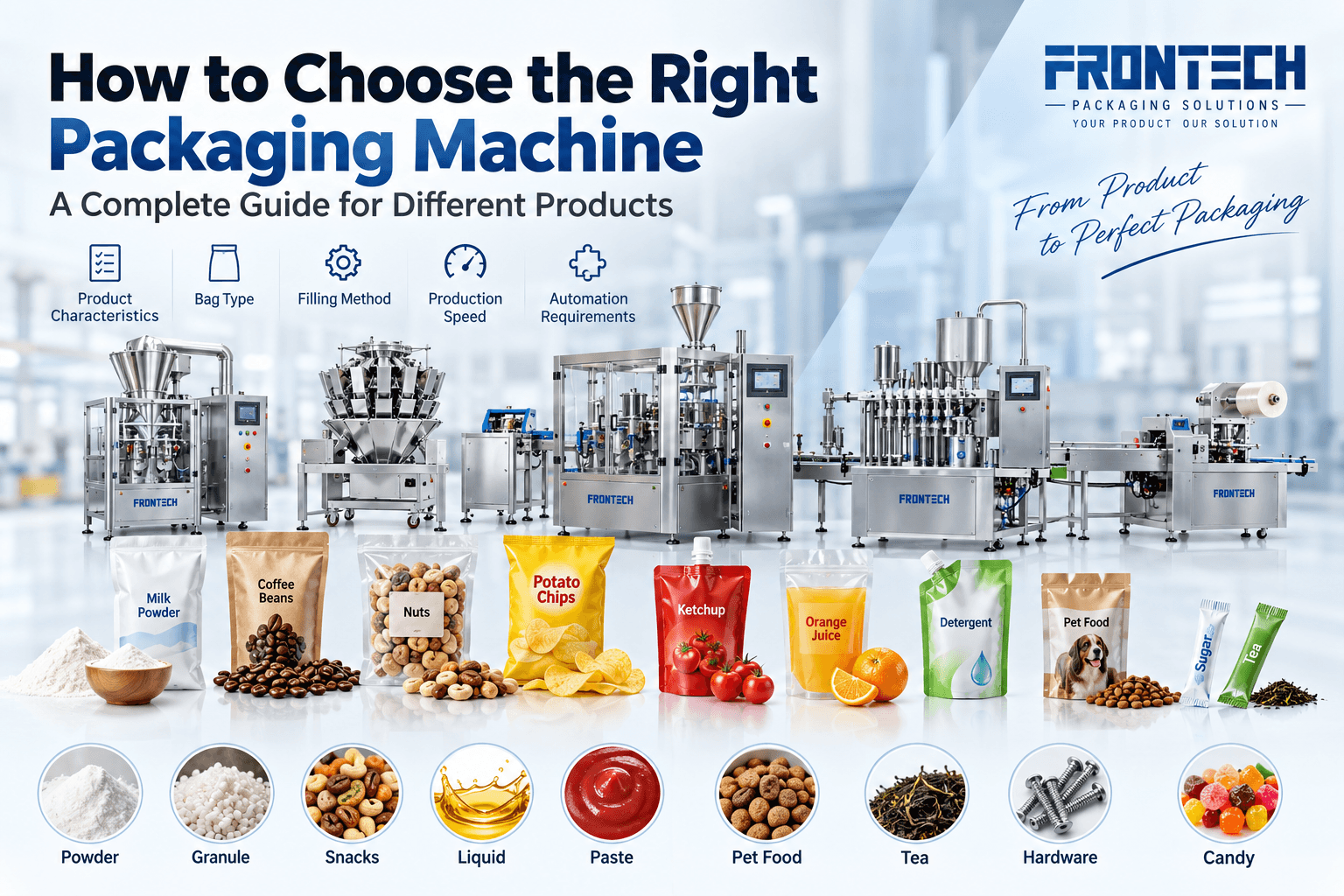
Choosing the right packaging machine is one of the most important decisions when building or upgrading an automated packaging line. Different products require different filling systems, bag types, sealing methods, and levels of automation.
A machine that works well for coffee beans may not be suitable for flour, while packaging ketchup requires a completely different filling system from packing nuts or potato chips.
In this guide, FRONTECH explains the key factors to consider when selecting a packaging machine and introduces common packaging solutions for powders, granules, snacks, liquids, pastes, and other products.
1. Start with Your Product Characteristics
The product itself is the first factor to consider.
Before selecting a machine, determine whether your product is:
- Powder
- Granule
- Free-flowing solid
- Fragile product
- Liquid
- Viscous paste
- Irregular-shaped product
- Product requiring counting
Different products require different dosing and filling technologies.
Powder Products
Products such as flour, milk powder, protein powder, coffee powder, spices, and chemical powders are commonly filled using an auger filler.
The screw-based dosing system provides controlled and repeatable filling, especially for fine powders that cannot be accurately handled by conventional weighing systems.
Typical machine configurations include:
VFFS Machine + Auger Filler
or
Premade Pouch Packing Machine + Auger Filler
2. Granules, Nuts and Seeds
Free-flowing products such as:
- Rice
- Beans
- Peanuts
- Almonds
- Pistachios
- Sunflower seeds
- Pumpkin seeds
- Coffee beans
can normally be handled using a multihead weigher, linear weigher, or volumetric cup filler.
For applications requiring higher weighing accuracy and production speed, a multihead weigher is usually preferred.
A typical automatic line may include:
Z-type Elevator → Multihead Weigher → Packing Machine → Finished Product Conveyor
The packing machine itself can be either a VFFS system or a premade pouch packing machine depending on the required package format.
3. Snacks and Fragile Products
Products such as potato chips, biscuits, crackers, puffed snacks, and other fragile foods require special attention during feeding and weighing.
Excessive drop height can cause product breakage.
For these applications, the packaging system should be designed to reduce the distance that the product falls through the weighing and filling process.
Multihead weighers are widely used because they provide fast and accurate portion control while suitable feeding and discharge systems can help minimize product damage.
Nitrogen flushing can also be integrated when required to help protect product freshness and improve package appearance.
4. Liquid Products
Free-flowing liquids such as:
- Water
- Juice
- Milk
- Soy milk
- Cooking oil
- Liquid detergent
normally require a liquid filling or pumping system.
Depending on the package format, the filling system can be integrated with:
- Premade pouch packing machines
- VFFS machines
- Spout pouch filling and capping machines
- Customized filling lines
The appropriate filling technology depends on factors such as viscosity, filling volume, required accuracy, production capacity, and hygiene requirements.
5. Sauces and Viscous Products
Ketchup, tomato sauce, mayonnaise, honey, jam, chili sauce, yogurt, and similar products require a filling system capable of handling higher viscosity.
Depending on the product, possible solutions include:
- Piston fillers
- Rotary pumps
- Servo-controlled filling systems
- Heated hoppers
- Agitated hoppers
For food applications, the parts that contact the product should be designed for easy cleaning and manufactured from suitable food-contact materials.
The characteristics of the sauce should always be tested before determining the final filling solution.
6. Choose the Right Bag Type
After determining the filling system, the next step is choosing the packaging format.
Common flexible packaging formats include:
Pillow Bags
Pillow bags are widely used for snacks, powders, granules, frozen foods, and many other products.
They are typically produced directly from roll film using a Vertical Form Fill Seal (VFFS) machine.
Premade Pouches
Premade pouches provide a more premium appearance and can support various pouch styles, including:
- Stand-up pouches
- Doypacks
- Zipper pouches
- Flat pouches
- Gusseted pouches
A rotary premade pouch packing machine automatically picks up, opens, fills, and seals the prepared bags.
Spout Pouches
Spout pouches are commonly used for beverages, sauces, liquid foods, detergents, and other liquid or semi-liquid products.
For these applications, dedicated spout pouch filling and capping machines can provide automatic pouch feeding, filling, cap feeding, and capping.
7. VFFS or Premade Pouch Packing Machine?
This is one of the most common questions when selecting packaging equipment.
Choose a VFFS Packing Machine When:
You require:
- High production efficiency
- Packaging from roll film
- Lower packaging material cost
- Pillow bags or similar formed bags
- Continuous automated production
VFFS machines form the package directly from roll film before filling and sealing it.
Choose a Premade Pouch Packing Machine When:
You require:
- Premium pouch appearance
- Stand-up pouches
- Zipper pouches
- Doypacks
- Greater flexibility in premade pouch styles
Premade pouch systems use bags that have already been manufactured by the packaging material supplier.
There is no universally better option. The right choice depends on your product, package style, production capacity, and operating cost.
8. Determine the Required Packaging Speed
Do not select a machine based only on the highest advertised speed.
Actual packaging speed depends on several factors:
Product characteristics + Filling weight + Bag dimensions + Filling system + Packaging material + Optional functions
For example, the same machine may achieve different speeds when packing 100 g of nuts and 1 kg of nuts.
The most reliable approach is to evaluate the complete packaging system rather than only the nominal speed of the main machine.
9. Consider Optional Functions
A packaging line can be equipped with additional systems according to production requirements.
Common options include:
- Nitrogen flushing
- Vacuum packaging
- Date coding
- Inkjet printing
- Metal detection
- Check weighing
- Automatic feeding
- Finished product conveying
- Bag opening detection
- Empty-bag detection
- Dust collection
- Automatic case packing
These functions should be selected according to the actual application rather than added unnecessarily.
10. Information to Provide Before Requesting a Packaging Machine
To recommend a suitable machine, a packaging machinery supplier normally needs several pieces of information.
Prepare:
1. Product
What product are you packing?
2. Filling weight or volume
For example: 100 g, 500 g, 1 kg or 1 L.
3. Bag type
Pillow bag, stand-up pouch, zipper pouch, flat pouch, spout pouch, etc.
4. Bag dimensions
Width × Length.
5. Required speed
For example: 30, 50 or 80 bags/min.
6. Packaging material
Provide the film structure if available.
7. Special requirements
Nitrogen flushing, vacuum, coding, metal detection, check weighing, etc.
Providing these details makes it much easier to select the correct filling and packaging system.
Conclusion
There is no single packaging machine suitable for every product.
A successful packaging solution requires the correct combination of:
Product Handling → Dosing/Filling → Bag Type → Packing Machine → Inspection → Secondary Packaging
For example:
Nuts → Multihead Weigher → Premade Pouch Machine → Nitrogen Flushing → Check Weigher
while another project may require:
Powder → Auger Filler → VFFS Machine → Date Coder → Finished Product Conveyor
FRONTECH provides packaging solutions for powders, granules, snacks, liquids, pastes, and other products using VFFS machines, premade pouch packing machines, multi-lane sachet machines, flow pack systems, filling equipment, and customized automatic packaging lines.
For machine selection, provide your product, filling weight, bag type, bag dimensions, and required production speed so that the packaging system can be configured according to your application.